

For many Houston homeowners, the phrase ac replacement usually brings one thing to mind: the budget. When the outdoor condenser unit finally calls it quits in the middle of a July humidity spike, the temptation to perform a “partial replacement” is massive. It sounds simple: just swap the outdoor box, keep the indoor evaporator coil, and save a few thousand dollars.
However, as we move through 2026, the technology behind your home’s climate control has changed significantly. Today, “mixing and matching” components from different generations isn’t just a technical compromise. It is a high-stakes gamble with your home’s comfort and your wallet.
The SEER2 Reality Check: It Is Not Just a Number
The biggest shift in the industry lately is the mandatory transition to SEER2 standards. If you have been looking at a seer2 vs seer comparison chart, you might think it is just a slight adjustment in efficiency ratings. That is not the case.
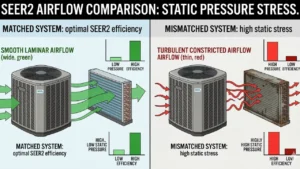
A seer to seer2 conversion involves a fundamental change in how your system handles air pressure. SEER2-compliant units are built to overcome higher static pressures, which means they use much more powerful fan motors. If you hook up a brand-new SEER2 condenser to an indoor coil designed for the older SEER 14 or 15 standards, you create a massive “pressure bottleneck.” This mismatch forces your system to work significantly harder, often leading to a premature ac blower motor replacement within the first two years.
Why “Unmatched” Systems Fail in the Texas Heat
When you have an unmatched hvac system, the equipment is physically unable to maintain the balance required for efficient cooling. In Houston, where our systems run almost non-stop, these imbalances show up fast in three specific ways:
1. The “Frozen Block” Syndrome
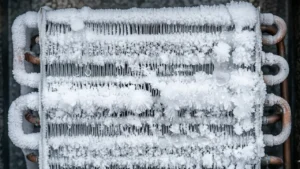
You might find yourself searching for why you have a frozen evaporator coil even when it is 95 degrees outside. This happens because a modern outdoor unit pumps refrigerant at a rate your old indoor coil cannot handle. The temperature of that old coil drops too low, too fast, turning the condensation into a block of ice. This can send liquid refrigerant back to the compressor, which is a guaranteed way to kill your new unit.
2. High Compressor Stress
The ac compressor replacement cost is the one bill no homeowner wants to see. In a mismatched system, the compressor stays under constant strain because the indoor and outdoor volumes are out of sync. While a matched system is built to last 15 years, many mismatched systems fail in under five.
3. The “Sticky House” Problem
In Houston, HVAC is really about dehumidification. An unmatched system often fails to remove humidity correctly because the cooling cycles are uneven. You might hit 72 degrees on the thermostat, but your skin will still feel sticky and uncomfortable.
The Warranty and Refrigerant Wall
If your older unit still runs on R-22 refrigerant, a partial replacement is effectively impossible. The pressures and oils used in modern R-410A or the newer A2L refrigerants used in 2026 are chemically incompatible with R-22 parts.
Beyond the chemistry, there is the legal side. Almost every major manufacturer, including Trane and Lennox, will void your warranty if the system is not a documented “Matched System.” If that new condenser fails next year, the manufacturer will likely deny your claim the moment they see it was connected to an obsolete indoor coil.
Conclusion: Total Value vs. Initial Price
While the initial cost of replacing ac components separately looks lower on a quote, the long-term reality is different. Between higher energy bills, frequent repair calls, and the lack of a valid warranty, a partial replacement often ends up costing twice as much as a full system upgrade over time.
The best way to protect your investment is to ensure your system meets 2026 compatibility standards. Before you sign off on a partial swap, have a professional perform a static pressure test on your ducts to see if your home is actually ready for the upgrade.
